


Cardiovascular Center
Center Overview
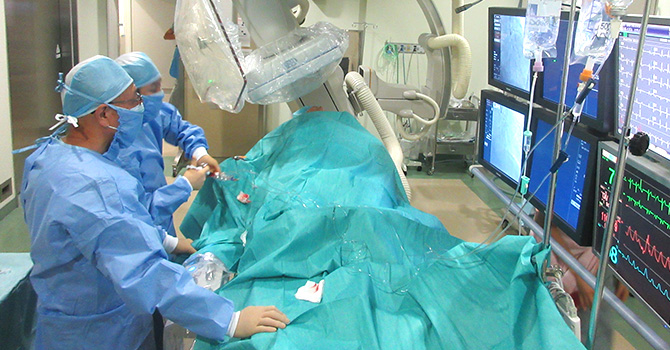
Our Cardiovascular Center provides comprehensive diagnostic testing and evidence-based treatment for a wide range of cardiovascular diseases. Depending on the condition, we utilize various examinations, including:
- X-ray imaging
- Electrocardiogram (ECG)
- Holter ECG
- Ergometer exercise stress test
- Cardiac ultrasound (echocardiography)
- Carotid artery ultrasound
- Coronary CT
- Pulse wave velocity testing
- MRI
Based on accurate diagnostic results, we provide not only medical therapy but also advanced interventional treatments to improve patients’ quality of life.
Treatment for Coronary Artery Disease
1) Cardiac Catheterization
Cardiac catheterization involves inserting a thin tube (catheter), approximately 2 mm in diameter, through an artery in the groin, wrist, or elbow and advancing it near the heart. Contrast dye is injected into the coronary arteries—the vessels supplying blood to the heart muscle—to visualize and evaluate areas of narrowing.
2) Percutaneous Coronary Intervention (PCI) / Stent Placement
Similar to cardiac catheterization, a 2 mm catheter is inserted through an artery in the hand or leg. A balloon catheter is used to dilate the narrowed portion of the coronary artery. Depending on the lesion characteristics, a
stent (metal coil) may be placed to keep the artery open and improve blood flow.
Peripheral Artery Treatment
Catheter Treatment for Lower-Limb Arteriosclerosis Obliterans
When the arteries in the legs become narrowed, patients may experience leg pain during walking or a sensation of coldness in the lower limbs. A catheter is inserted through an artery in the hand or leg, and—similar to coronary treatment—balloons or stents are used to dilate the narrowed segments.
Treatment for Arrhythmias
1) Treatment for Tachyarrhythmias
Radiofrequency Catheter Ablation
This treatment is used when medications are ineffective for conditions such as atrial fibrillation or supraventricular tachycardia. A catheter is used to deliver radiofrequency energy to ablate (destroy) the area of heart tissue causing the arrhythmia.
It is significantly more effective than medication, although recurrence may occur, in which case a second procedure may be performed.
2) Treatment for Bradyarrhythmia
Permanent Pacemaker Implantation
Our cardiology department has long performed permanent pacemaker implantation for bradyarrhythmia. Depending on the type of arrhythmia, atrial, ventricular, or dual-chamber pacemakers are selected.
Previously, patients with pacemakers could not undergo MRI examinations. However, with the development of MRI-compatible pacemakers, we now implant MRI-compatible devices for eligible new patients.